
If you have been diagnosed with a herniated or bulging disc, you may be wondering whether you need surgery, medication, physical therapy, or whether a chiropractor can help.
The short answer is: chiropractic care may be an option for some people with back pain associated with a disc problem, but it is not appropriate for every patient or every type of disc-related condition. A proper evaluation is important before deciding whether spinal manipulation or another conservative treatment is appropriate.
Spinal manipulation is one of several non-drug approaches used for low-back pain. Research summarized by the National Center for Complementary and Integrative Health (NCCIH) indicates that spinal manipulation can produce small improvements in pain and function for some people with acute or chronic low-back pain. However, the evidence does not mean that every person with a herniated or bulging disc will benefit from manipulation.
This guide explains the difference between bulging and herniated discs, common symptoms, diagnosis, chiropractic treatment, spinal decompression, recovery, exercises, warning signs, and when other medical treatment may be necessary.
Dealing with disc pain in Colorado Springs? Get a thorough evaluation to find out what’s behind your symptoms and whether chiropractic care is a good fit for you.
Book Now or call (719) 471-4174
What is a Spinal Disc?

Spinal discs are cushions located between the vertebrae of your spine. Each disc contains a softer inner portion surrounded by a tougher outer layer. They help separate the vertebrae and allow the spine to move. (For a closer look at how the spine is built, see our spine education resources.)
As discs age, they can become less flexible and more susceptible to changes or injury. A disc can also be affected by trauma, repetitive movements, lifting, or twisting.
A problem with a disc does not automatically mean that it will cause symptoms. Some people have disc abnormalities without pain or other noticeable symptoms.
What is a Bulging Disc?
A bulging disc occurs when a spinal disc extends outward beyond its usual boundary. The degree and location of the bulge matter because a disc abnormality does not necessarily cause symptoms.
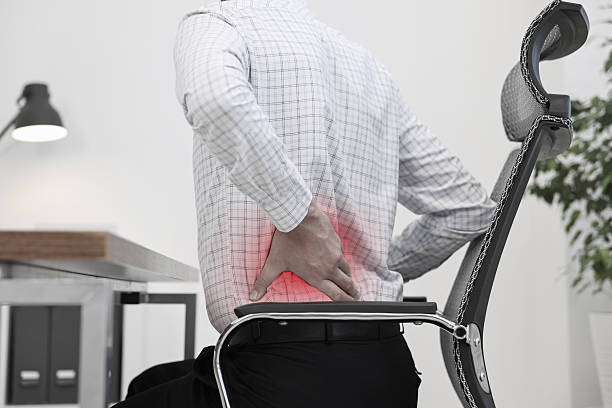
A bulging disc may be associated with age-related changes in the spine, repetitive movements, or other mechanical stresses. Some people may have a bulging disc without knowing it, while others may experience back or neck pain or symptoms caused by irritation of nearby nerves.
What is a Herniated Disc?
A herniated disc occurs when part of the softer inner material of a spinal disc pushes through a tear or weakened area in the outer layer. If the herniated material irritates or compresses a nearby nerve, it can produce pain, numbness, tingling, or weakness.
Herniated discs most commonly affect the lower back, although they can also occur in the neck. Symptoms depend on the location of the disc problem and whether a nearby nerve is affected.
Bulging Disc vs. Herniated Disc: What’s the Difference?
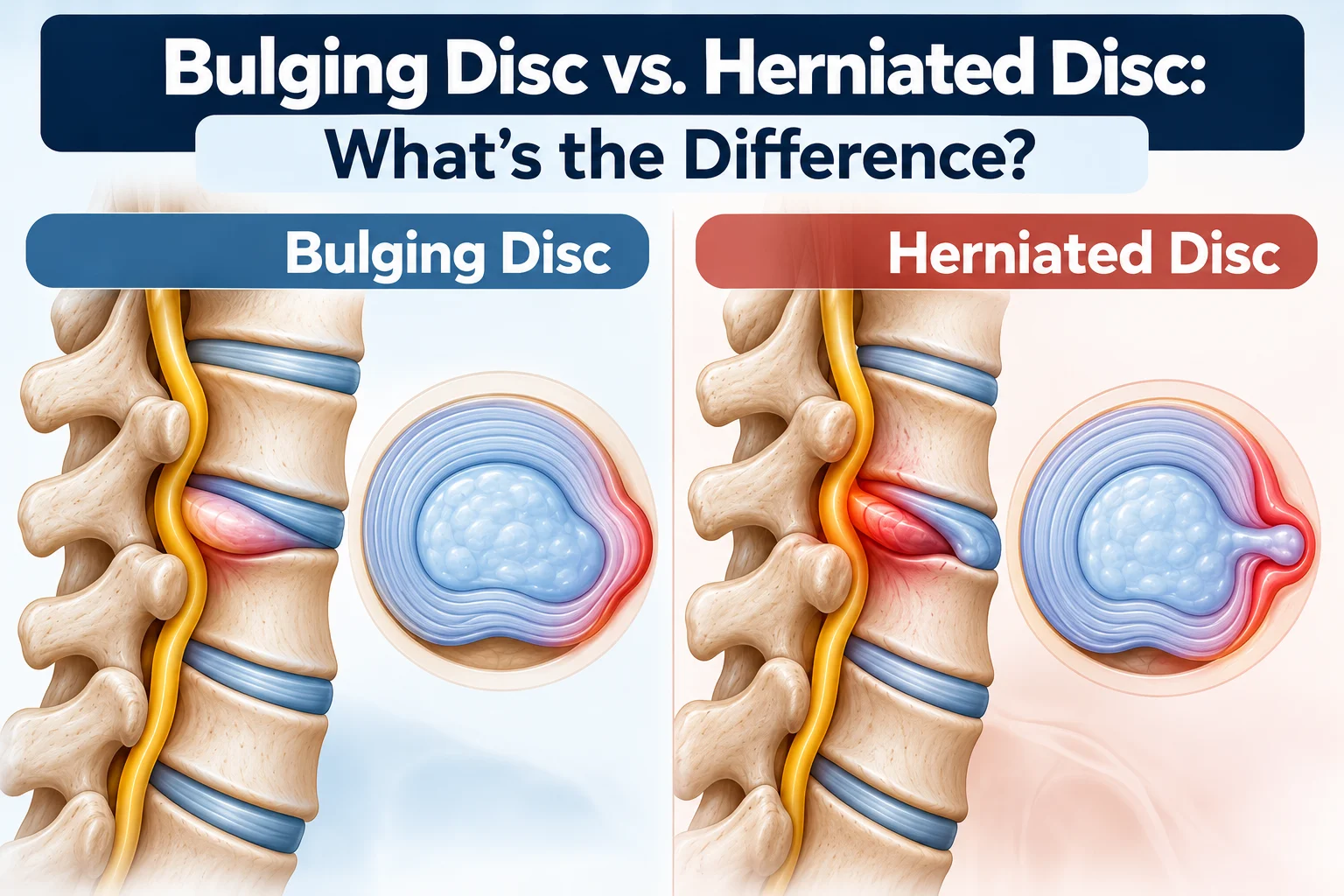
Although the terms are sometimes used interchangeably in everyday language, they can describe different disc changes.
Bulging Disc |
Herniated Disc |
|
What happens |
The disc extends outward beyond its normal boundary | Part of the softer inner material pushes through a tear or weakened area in the outer layer |
Outer layer |
Generally intact | Torn or weakened |
Area affected |
Often a broader portion of the disc | Usually a more localized area |
Common causes |
Often linked to age-related disc changes | Age-related changes, lifting, twisting, or injury |
Symptoms |
May cause no symptoms, or back or neck pain if nearby nerves are irritated | May cause no symptoms, or pain, numbness, tingling, or weakness if a nerve is irritated or compressed |
Seen on X-ray? |
No | No |
Seen on MRI? |
Yes | Yes |
Typical first treatment |
Conservative care, such as activity changes, exercise, and pain management | Conservative care, such as activity changes, exercise, and pain management |
The important point is that the appearance of a disc on imaging does not, by itself, determine how much pain someone will experience. Symptoms depend on factors such as the location of the disc problem and whether nerves are being irritated or compressed.
Not sure whether you have a bulging or herniated disc? Dr. Austin Clarke can review your symptoms and imaging and explain what they mean for you.
Is a Slipped Disc the Same as a Herniated Disc?
“Slipped disc” is a common term used for a herniated disc. Medical sources such as the NHS and Mayo Clinic use “slipped disc” when discussing a herniated or prolapsed disc.
However, a disc does not literally “slip” out of the spine. The term generally describes a disc that has bulged or herniated.
What Are the Symptoms of a Herniated or Bulging Disc?
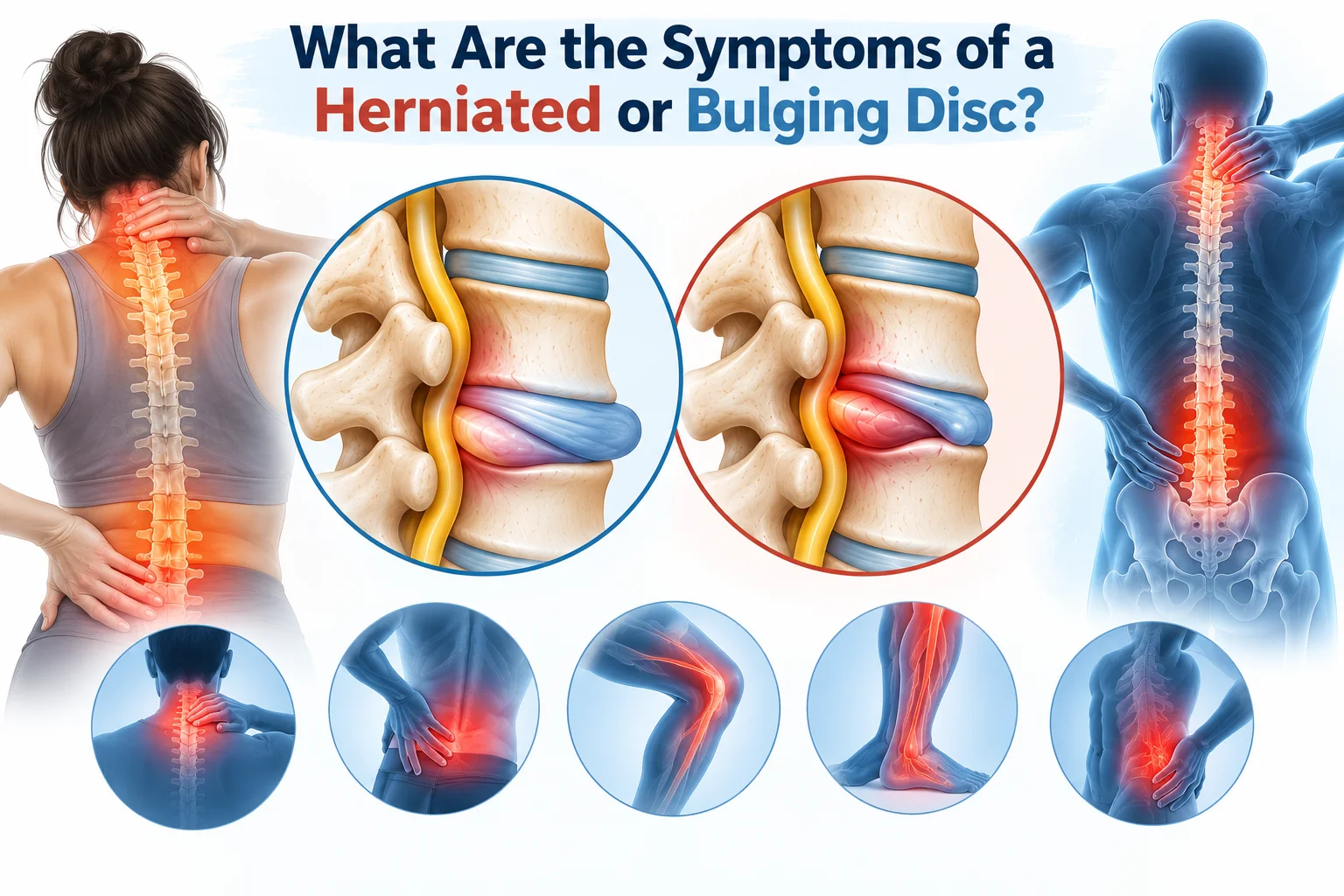
Symptoms vary depending on the location of the disc problem and whether a nerve is affected.
Some people have no symptoms at all. Others may experience pain, numbness, tingling, or weakness.
Lower Back Disc Symptoms
A disc problem in the lower back may cause:
- Lower back pain
- Pain in the buttocks or hips
- Pain traveling into the thigh, calf, or foot
- Numbness or tingling in the leg or foot
- Muscle weakness
- Sciatica when the sciatic nerve is affected
Neck Disc Symptoms
A herniated disc in the neck can cause:
- Neck pain
- Shoulder pain
- Pain traveling into the arm
- Numbness or tingling in the arm or hand
- Weakness involving muscles connected to an affected nerve
Neck disc problems can sometimes follow a whiplash injury or other trauma.
Pain may become more noticeable with certain movements, coughing, sneezing, or other activities depending on the individual condition.
Can a Herniated Disc Cause Sciatica?
Yes. A lower-back disc problem can irritate a nerve that contributes to the sciatic nerve, producing pain that travels from the lower back or buttock into the leg. Learn more about sciatica.
Sciatica can also be accompanied by numbness, tingling, or weakness.
Could Your Symptoms Be Something Else?
Not every case of back pain, numbness, or radiating pain comes from a disc. Back pain can result from sprains and strains or arthritis. Numbness or tingling in the hands may come from carpal tunnel syndrome, and numbness in the feet or hands can be a sign of peripheral neuropathy. Shoulder pain may come from a rotator cuff problem rather than a neck disc.
This is one reason a thorough evaluation matters before starting any treatment.
Recognize these symptoms? Leg pain, arm pain, numbness, or tingling linked to a disc problem deserves a proper evaluation. We’ll assess your symptoms and tell you honestly whether chiropractic care is appropriate, or whether you should see a medical doctor first.
Book Now or call (719) 471-4174
What Causes Herniated and Bulging Discs?
Disc problems can develop for several reasons.
Common contributing factors include:
- Age-related changes in the discs
- Traumatic injuries, such as car accidents
- Repetitive bending or twisting
- Improper lifting techniques
- Prolonged sitting
- Smoking
- Excess body weight
- Certain physically demanding activities, including work-related strain and high-demand sports
In many cases, there is not one single event that explains why a disc problem developed. Changes can occur gradually as discs become less flexible over time.
Back pain from lifting, sitting, or an old injury? Find out what’s contributing to your symptoms with a thorough exam at our Colorado Springs office.
Book Now or call (719) 471-4174
How is a Herniated or Bulging Disc Diagnosed?
A healthcare professional generally begins with your symptoms and a physical examination.
The examination may include checking:
- Muscle strength
- Reflexes
- Sensation
- Walking ability
- Range of motion
- Pain patterns
- Neurological function
Do You Need an MRI?
Not everyone with back pain needs an MRI immediately.
MRI can provide detailed images of soft tissues and can help identify the location of a herniated disc and whether nerves are affected.
The American Association of Neurological Surgeons notes that MRI generally isn’t recommended unless symptoms have lasted about six weeks, though urgent imaging is warranted for red-flag symptoms such as significant weakness or loss of bladder or bowel control.
Can an X-Ray Show a Herniated Disc?
A standard X-ray cannot directly show a herniated disc. It can, however, help identify or rule out other problems involving the bones and alignment of the spine.
Depending on the situation, a healthcare professional may consider MRI, CT, or nerve tests such as electromyography.
Need an exam or X-rays? Our $49 New Patient Special includes a consultation, full exam, and X-rays if needed.
Can a Chiropractor Help With a Herniated Disc?
A chiropractor may be able to help some people manage low-back pain associated with a disc problem, but chiropractic care is not appropriate for everyone with a herniated disc.
Mayo Clinic lists chiropractic care among alternative treatments that some people find helpful for long-term back pain. NCCIH also reports that spinal manipulation may produce small improvements in pain and function for acute or chronic low-back pain.
However, evidence for spinal manipulation is primarily discussed in the context of low-back pain generally, rather than proving that manipulation repairs a herniated disc itself. Therefore, it is more accurate to describe chiropractic care as a possible part of conservative symptom management rather than a guaranteed method of correcting the disc abnormality.
Can a Chiropractor Help With a Bulging Disc?
The same principle applies to a bulging disc.
A chiropractor may evaluate your symptoms, movement, and neurological status and determine whether conservative chiropractic care is appropriate.
The goal is not simply to treat an MRI finding. The more important question is whether your symptoms, examination findings, and functional limitations are consistent with a condition that may benefit from conservative care.
Not sure if chiropractic care is right for your disc problem? Our team can evaluate your symptoms and let you know whether conservative care is a good fit, or whether you’d be better served by another provider.
Can a Chiropractor Fix a Herniated or Bulging Disc?
It is important to be realistic about what chiropractic treatment can and cannot do.
A chiropractic adjustment should not be described as physically “pushing a disc back into place.”
Spinal manipulation involves applying a controlled force to a spinal joint. Research supports its use as one possible non-drug treatment for low-back pain, but that does not establish that manipulation physically returns a herniated disc to its original position.
For someone with a disc problem, the goals of conservative care may instead include reducing symptoms, improving movement and function, and helping the person return to appropriate activity.
How Can Chiropractic Care Help a Herniated or Bulging Disc?
Treatment should be individualized rather than based only on the diagnosis written on an imaging report.
Chiropractic Adjustments
Spinal manipulation uses the hands or a device, such as the Activator or Arthrostim, to apply a controlled thrust to a spinal joint. Some chiropractors use specific hands-on systems, such as the Gonstead technique. NCCIH describes spinal manipulation as one of several non-drug approaches that may provide small improvements in pain and function for people with low-back pain.
Whether manipulation is appropriate depends on the patient’s symptoms, examination findings, medical history, and other risk factors.
Spinal Decompression
Spinal decompression is intended to reduce pressure and ease pain. Cleveland Clinic lists bulging discs, herniated discs, pinched nerves, and sciatica among conditions for which people may seek decompression therapy.
Depending on your evaluation, decompression-style care may include flexion-distraction or intersegmental traction.
However, patients should ask the treating professional what type of decompression is being recommended, why it may be appropriate for their condition, and what outcome can realistically be expected.
Soft-Tissue Treatment
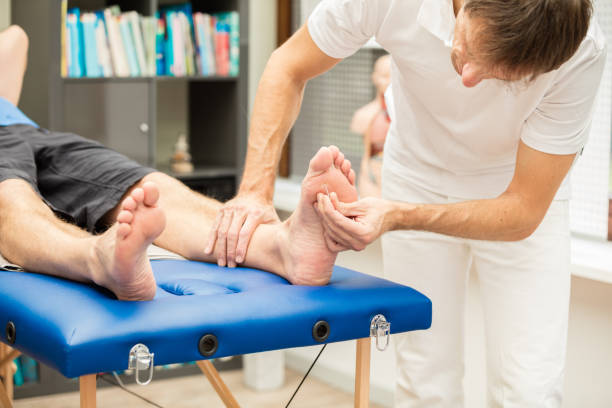
Some treatment plans may also address surrounding muscle tension and movement limitations through approaches such as myofascial release, Active Release Technique, or dry needling.
The appropriate approach depends on the individual’s examination and symptoms rather than simply whether an MRI shows a disc bulge or herniation.
Other Supportive Therapies
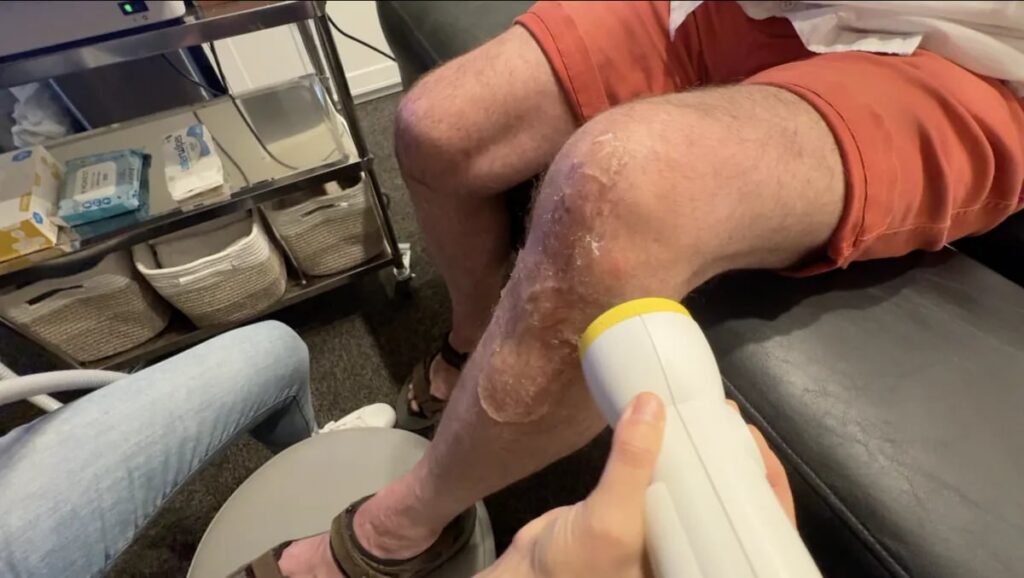
Depending on your evaluation, a treatment plan may also include supportive therapies such as laser therapy, shockwave therapy, or Softwave. The research on these therapies for disc problems is more limited than for exercise or spinal manipulation, so ask your provider why a therapy is being recommended and what results to realistically expect.
Therapeutic Exercise
Exercise and physical therapy are commonly used as part of conservative management for disc-related problems.
For example, Mayo Clinic notes that physical therapists can teach positions and exercises designed to minimize the pain of a herniated disk.
The NHS also recommends gradually returning to gentle activity rather than remaining inactive for prolonged periods, provided the activity does not worsen symptoms.
Posture and Movement Guidance
Treatment may also include education about movement, lifting, sitting, and other activities that may aggravate symptoms.
Good posture and proper lifting techniques are among measures recommended by orthopedic and medical sources for reducing strain on the back.
Is Chiropractic Treatment Safe for a Herniated or Bulging Disc?
Safety depends on the individual’s condition and the treatment being performed.
NCCIH reports that spinal manipulation is generally associated with temporary, mild-to-moderate side effects such as soreness, stiffness, discomfort, or headache. Serious complications are considered very rare, although they have been reported.
NCCIH also notes that, in people whose pain is caused by a herniated disc, lower-back manipulation appears to have a very low chance of worsening the herniation.
At the same time, Mayo Clinic notes that chiropractic adjustment can have complications, including possible worsening of a herniated disc or nerve compression, and advises against chiropractic adjustment in certain circumstances, including when someone has numbness, tingling, or loss of strength in an arm or leg.
Because recommendations can differ according to the patient’s presentation, a thorough evaluation and communication of your medical history are important before treatment.
Can a Herniated or Bulging Disc Heal on Its Own?
Many people improve without surgery.
The AANS states that the majority of herniated discs do not require surgery and that symptoms of sciatica or radiculopathy improve in approximately 9 out of 10 people.
The NHS similarly states that a slipped disc usually improves gradually with conservative measures such as maintaining appropriate activity and managing pain.
This does not mean that every disc problem will resolve quickly or that symptoms should be ignored. Persistent, worsening, or neurological symptoms should be evaluated.
How Long Does a Herniated or Bulging Disc Take to Heal?
Recovery varies from person to person.
Cleveland Clinic states that many herniated discs improve within about four to six weeks, while AANS notes that symptoms may improve over a period ranging from several days to several weeks.
Recovery can depend on factors such as:
- Location of the disc problem
- Whether a nerve is affected
- Severity of symptoms
- Duration of symptoms
- Response to conservative treatment
- Overall health and activity level
There is no single recovery timeline that applies to every patient.
What Are the Signs a Herniated Disc Is Healing?
Improvement may be reflected by changes such as:
- Less pain
- Less radiating pain
- Reduced numbness or tingling
- Improved movement
- Improved strength
- Greater ability to perform normal activities
The important measure is improvement in symptoms and function rather than assuming that an imaging abnormality must completely disappear.
What Are the Signs a Bulging or Herniated Disc Is Getting Worse?
Contact a healthcare professional if symptoms are worsening, particularly if you develop:
- Increasing pain
- New or worsening numbness
- Increasing weakness
- Difficulty standing or walking
- Increasing difficulty performing everyday activities
Neurological changes are particularly important because a disc problem can sometimes compress a nerve.
Can You Exercise With a Herniated or Bulging Disc?
In many cases, remaining appropriately active is preferable to prolonged bed rest.
The NHS recommends gradually returning to gentle activity such as walking, swimming, or yoga as tolerated, provided the activity does not cause pain or make back pain worse.
AANS also states that bed rest is not recommended for typical herniated-disc cases and encourages walking as tolerated.
However, exercise should be individualized. An exercise that feels appropriate for one person may aggravate symptoms in another.
What Exercises Should You Avoid With a Herniated Disc?
Rather than following a universal list of “bad” exercises, pay attention to activities that worsen your symptoms.
Depending on the condition, a healthcare professional may recommend temporarily modifying activities involving:
- Heavy lifting
- Repetitive bending
- Repetitive twisting
- High-impact movements that aggravate symptoms
- Movements that increase radiating pain, numbness, or weakness
The goal is not necessarily to avoid movement altogether. It is to find an appropriate level of activity while symptoms are being managed.
How Should You Sleep With a Herniated or Bulging Disc?
There is not one sleeping position that works for everyone with a disc problem.
Instead, focus on a position that allows you to sleep comfortably without significantly increasing your symptoms.
If a particular position consistently increases radiating pain, numbness, or discomfort, discuss it with your healthcare professional rather than forcing yourself to remain in that position.
Do Back Braces Help With a Bulging or Herniated Disc?
A back brace may provide support in some circumstances, but it should not be viewed as a way to repair a damaged disc.
Whether a brace is appropriate depends on the individual’s condition and treatment plan.
Because prolonged inactivity can contribute to stiffness and may not be beneficial for many people with disc problems, a brace should not automatically be treated as a substitute for appropriate movement or rehabilitation.
What Other Treatments Are Available for a Herniated or Bulging Disc?
Chiropractic care is only one possible conservative approach.
Depending on the individual’s condition, healthcare professionals may consider:
Physical Therapy
Physical therapy can include individualized exercises, stretching, movement training, and other approaches intended to improve strength, mobility, and function.
Medication
Healthcare professionals may recommend medications for pain or inflammation when appropriate. Medication choice depends on the person’s health, other medications, and medical history.
Epidural or Nerve Injections
In some cases, a steroid injection near an affected nerve may be considered when symptoms do not improve with other measures.
Surgery
Most people with herniated discs do not need surgery. Surgery may be considered when symptoms remain severe or persistent despite conservative treatment, or when significant neurological problems develop.
When Does a Herniated Disc Require Surgery?
A herniated disc does not automatically mean that surgery is necessary.
AANS states that surgery may be considered when symptoms significantly interfere with normal activities, progressive neurological deficits develop, bowel or bladder function is affected, walking or standing becomes difficult, or conservative treatment has not been effective.
Mayo Clinic similarly notes that most people do not need surgery, but it may be considered when symptoms remain serious or do not improve with conservative care.
The decision should be made with an appropriate medical professional after considering symptoms, examination findings, imaging when indicated, and response to treatment.
When Should You See a Doctor Instead of a Chiropractor?
Some symptoms require prompt medical evaluation rather than routine conservative care.
Seek urgent medical attention if you experience:
- Loss of bladder or bowel control
- Numbness around the buttocks, genitals, or saddle area
- Significant or progressive weakness
- Major loss of sensation
- Severe difficulty walking
- Symptoms following significant trauma
These symptoms can indicate serious nerve compression. The NHS specifically advises emergency evaluation for back pain accompanied by numbness around the genitals or bottom, inability to urinate, loss of feeling in one or both legs, or loss of bladder or bowel control.
If you have any of these symptoms, call 911 or go to the nearest emergency room. Don’t drive yourself.
Cauda equina syndrome is a medical emergency that can occur when nerve roots at the bottom of the spinal canal become severely compressed. Rapid treatment may help prevent permanent complications.
What Happens During a Chiropractic Evaluation for a Herniated Disc?
A first appointment should involve more than simply receiving an adjustment.
A chiropractor may ask about:
- When your symptoms started
- Where the pain occurs
- Whether pain travels into an arm or leg
- Numbness or tingling
- Muscle weakness
- Previous injuries
- Your medical history
- Activities that make symptoms better or worse
A physical examination may assess movement, strength, reflexes, sensation, and other findings.
Mayo Clinic notes that a chiropractic visit can include a health-history review and physical examination, with additional testing when appropriate.
The purpose of this evaluation is to determine whether chiropractic care is appropriate or whether another type of medical evaluation is more suitable.
Ready for your evaluation? New patients can start with our $49 New Patient Special, which includes a consultation, full chiropractic exam, X-rays if needed, and a report of findings.
Book Now or call (719) 471-4174
Questions about cost or insurance? See our payment options.
Frequently Asked Questions
Can a chiropractor help a herniated disc?
A chiropractor may help some people manage low-back pain associated with a disc problem. Spinal manipulation can provide modest improvements in pain and function for some people with low-back pain, but it should not be presented as a guaranteed treatment for the disc herniation itself.
Can a chiropractor help a bulging disc?
Potentially. A chiropractor can evaluate the person’s symptoms and determine whether conservative chiropractic care is appropriate. Treatment should be based on the individual’s clinical presentation rather than the imaging finding alone.
Can a chiropractor fix a herniated disc without surgery?
Chiropractic care may help manage symptoms and improve function, but it should not be described as physically putting a herniated disc back into place. Many people with herniated discs improve without surgery, but that improvement can occur through natural recovery and various conservative treatments.
Can chiropractic care make a herniated disc worse?
There are potential risks with spinal manipulation, and Mayo Clinic notes that an adjustment can make a herniated disc worse. At the same time, NCCIH reports that lower-back manipulation appears to have a very low chance of worsening a herniation in people whose pain is caused by a herniated disc.
This is why appropriate patient selection and evaluation matter.
Is chiropractic adjustment safe for a herniated disc?
Safety depends on the individual’s condition and the type of treatment being considered. Spinal manipulation can cause temporary soreness or discomfort, while serious complications are rare. People should disclose relevant medical conditions and symptoms to the practitioner before treatment.
Can a chiropractor help with sciatica caused by a herniated disc?
Chiropractic care may be one conservative approach for some people with low-back pain and related symptoms. However, sciatica accompanied by significant or progressive weakness, major numbness, or bladder/bowel changes requires medical evaluation.
Do I need an MRI before seeing a chiropractor?
Not necessarily. Imaging is not automatically required for every person with back pain. Whether an MRI is appropriate depends on symptoms, examination findings, duration, and whether there are neurological signs.
Can a bulging disc become a herniated disc?
Bulging and herniation describe different disc changes, but disc degeneration and weakening can contribute to both. A healthcare professional can interpret imaging findings in the context of your symptoms rather than assuming that one condition will inevitably progress to the other.
Can a herniated disc heal without surgery?
Yes. Most herniated discs do not require surgery, and many people improve with conservative treatment or over time.
How many chiropractic sessions are needed for a herniated disc?
There is no scientifically established number of chiropractic sessions that applies to everyone with a herniated disc. The appropriate treatment frequency depends on the individual’s symptoms, examination findings, response to care, and overall treatment plan.
When should I stop chiropractic treatment?
Treatment should be reassessed if symptoms are worsening, new neurological symptoms appear, or expected improvement is not occurring. Progressive weakness, significant numbness, bladder or bowel problems, or saddle-area numbness require prompt medical evaluation rather than simply continuing routine chiropractic care.
Herniated & Bulging Disc Treatment in Colorado Springs
If back or neck pain is affecting your daily activities, an evaluation can help determine what may be contributing to your symptoms and whether conservative chiropractic care is appropriate.
A Colorado Springs chiropractor can evaluate your symptoms, discuss your treatment options, and determine whether chiropractic care should be part of your overall approach. After your symptoms improve, ask about wellness care and strategies to help reduce your risk of future flare-ups.
If you have severe or progressive neurological symptoms, significant weakness, loss of bladder or bowel control, or numbness around the groin or saddle area, seek urgent medical attention rather than delaying care for a chiropractic appointment.
What Our Patients Say
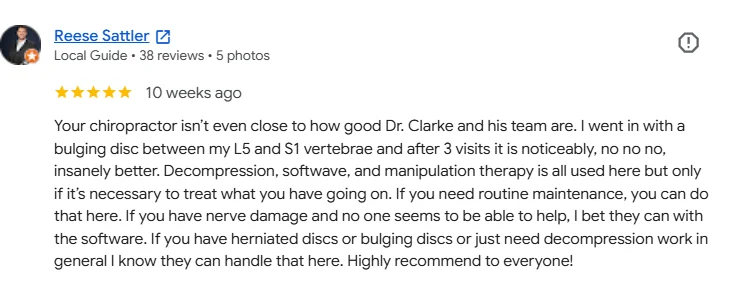
“I went in with a bulging disc between my L5 and S1 vertebrae and after 3 visits it is noticeably… insanely better. Decompression, softwave, and manipulation therapy is all used here but only if it’s necessary to treat what you have going on.”
Reese Sattler, Google Review ★★★★★
Individual results vary. Your treatment plan will depend on your evaluation.
If you are experiencing symptoms of a herniated or bulging disc, schedule an evaluation to discuss your condition and appropriate treatment options.
Book Now | Call (719) 471-4174 | 1819 West Colorado Ave., Colorado Springs, CO 80904