
Joint pain can show up for a lot of reasons. But when it lingers, gets worse, or starts limiting your daily life, arthritis is often the culprit.
The question is, which kind?
Osteoarthritis vs rheumatoid arthritis is one of the most common comparisons people search for once they start digging into their symptoms. Both conditions cause joint pain, stiffness, and swelling. But they come from completely different places in the body, and they need different treatment approaches.
This guide breaks down what separates the two, so you know what to watch for and when to get evaluated.
Not sure which one matches what you’re feeling? Book an Appointment with our team and we’ll help you find out.
What Is Arthritis, Exactly?
Arthritis isn’t one disease. It’s an umbrella term for more than 100 conditions that affect the joints and the tissue around them.
In the United States, arthritis affects roughly 1 in 5 adults. That’s tens of millions of people dealing with joint pain in some form.
Of those 100-plus types, osteoarthritis and rheumatoid arthritis are two of the most common. They’re also two of the most frequently confused, since early symptoms can look similar on the surface.
What Is Osteoarthritis?

Osteoarthritis (OA) is the most common form of arthritis.
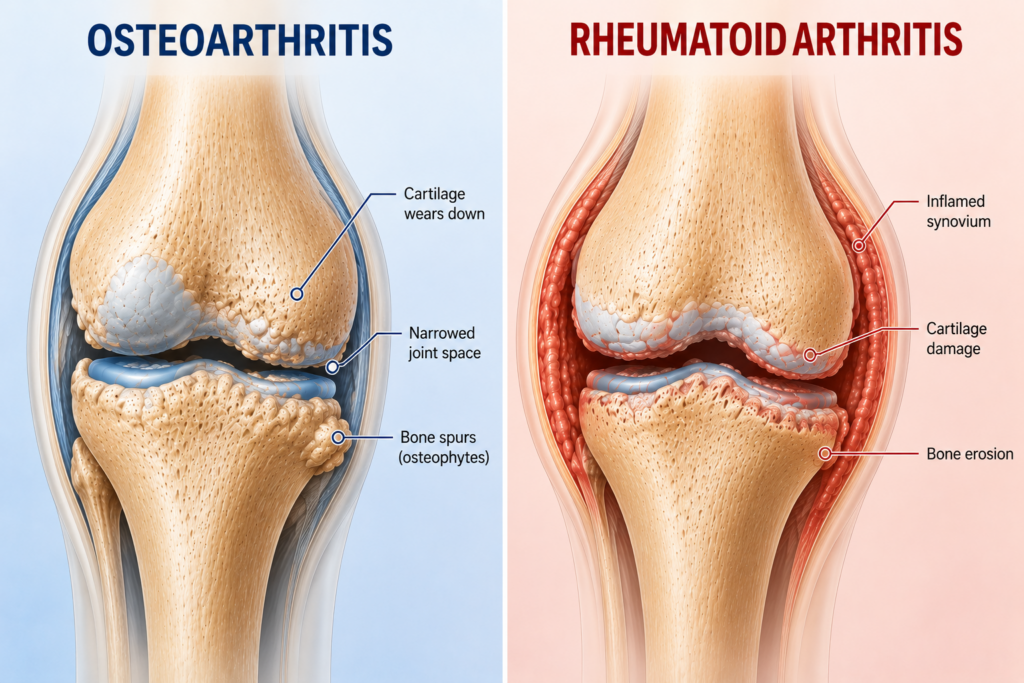
Some people call it degenerative joint disease. Others call it “wear and tear” arthritis. Both names point to the same thing: cartilage, the cushioning tissue at the ends of your bones, gradually breaks down over time.
As that cartilage wears away, bones can start rubbing against each other. This leads to pain, stiffness, and eventually changes in the bone itself.
OA shows up most often in the hands, hips, back, and knees. An estimated 33 million adults in the U.S. currently live with it.
Osteoarthritis Symptoms
Osteoarthritis symptoms tend to build gradually rather than appear overnight. Common signs include:
-
Pain during or after movement
-
Stiffness, especially first thing in the morning or after sitting > for a while
-
Tenderness around the joint
-
Reduced range of motion
-
A grating or popping sensation when the joint moves
-
Bone spurs
-
Mild swelling
What Raises Your Risk of Osteoarthritis?
A few factors make OA more likely:
-
Getting older
-
Being female
-
Carrying extra body weight
-
Past joint injuries, such as an ACL tear
-
Jobs or activities that involve repetitive joint stress
If you already have OA in one joint, you’re also more likely to develop it in others down the road.
There’s no cure for osteoarthritis. But with the right treatment plan, symptoms can be managed well.
If these symptoms sound familiar, Book an Appointment for a hands-on evaluation.
What Is Rheumatoid Arthritis?

Rheumatoid arthritis works nothing like OA.
It’s an autoimmune and inflammatory disease. Instead of wear and tear, your immune system mistakenly attacks your own joint tissue, specifically the synovium, which is the lining that surrounds each joint.
That attack triggers chronic inflammation. Left untreated, it can damage cartilage and bone over time.
RA most often affects the hands, wrists, and knees. It also tends to show up symmetrically, meaning it hits the same joints on both sides of the body at once. If your right hand is affected, your left hand often follows.
Because RA is a systemic disease, it isn’t limited to the joints. It can also affect the lungs, heart, and eyes.
Rheumatoid Arthritis Symptoms
Rheumatoid arthritis symptoms often include:
-
Joint pain, swelling, and stiffness, usually in matching joints on > both sides
-
Fatigue
-
Low-grade fever
-
A general sense of feeling unwell
Researchers haven’t pinned down an exact cause for RA. Most believe it results from a mix of genetics and environmental triggers, such as smoking or certain infections.
Worldwide, about 1% of people have RA, and women are affected two to three times more often than men.
Dealing with joint pain on both sides of your body? Book an Appointment so we can take a closer look.
Osteoarthritis vs Rheumatoid Arthritis: Key Differences
Osteoarthritis
-
Cause: Mechanical wear on cartilage
-
Joint pattern: Often one joint or one side
-
Common joints: Hands, hips, back, knees
-
Onset: Gradual, over years
-
Systemic symptoms: Usually joint-only
-
Who it affects: Risk rises with age
Rheumatoid Arthritis
-
Cause: Autoimmune attack on joint lining
-
Joint pattern: Usually symmetrical, both sides
-
Common joints: Hands, wrists, knees
-
Onset: Can progress more quickly
-
Systemic symptoms: Fatigue, fever, organ involvement possible
-
Who it affects: Any age; most common ages 50 to 59
How Are They Diagnosed?
Diagnosis for both conditions usually starts the same way.
Your provider will review your health and family history. Then comes a physical exam, followed by imaging like X-rays.
From there, the path can split. Lab work and, in some cases, joint fluid testing help determine whether inflammation, an autoimmune process, or plain mechanical wear is behind your symptoms. A rheumatologist often gets involved when the picture isn’t clear.
A chiropractor can also play a useful role early on. Through a detailed history, physical exam, and joint mobility testing, an experienced chiropractor can often spot patterns pointing toward osteoarthritis or an inflammatory condition like RA.
Our own team at Colorado Injury & Wellness covers this in more depth here: Can a Chiropractor Tell If You Have Arthritis? It walks through exactly what that evaluation looks like, and when a referral for bloodwork or specialist care makes sense.
Treatment Approaches
For Osteoarthritis
Since OA damage can’t be reversed, treatment focuses on managing symptoms. This typically includes:
-
Staying physically active
-
Maintaining a healthy weight
-
Physical or occupational therapy
-
Medications for pain and inflammation
-
Joint replacement surgery in severe cases
For Rheumatoid Arthritis
RA treatment aims to calm inflammation and slow disease progression. Common approaches include:
-
Medications that target the immune system
-
Regular physical activity and weight management
-
Avoiding repetitive joint stress
-
Quitting smoking, a known risk factor that can worsen RA
Ready to build a treatment plan that fits your joints? Book an Appointment today.
Chiropractic Care for Osteoarthritis and Rheumatoid Arthritis

Since both conditions fall under the broader arthritis umbrella, chiropractic care can play a supporting role for either one, though the approach looks different depending on which type you have.
A chiropractor cannot cure arthritis, reverse cartilage loss, stop an autoimmune disease, or replace medication or surgery when that’s medically necessary. What chiropractic care can do is focus on improving joint mobility, reducing muscle tension, and supporting healthier movement patterns alongside your broader treatment plan.
Chiropractic Care for Osteoarthritis
For osteoarthritis, chiropractic care may help improve mobility and flexibility in affected joints such as the neck, back, hips, shoulders, and knees. This is typically combined with stretching and targeted exercise. Safety considerations, such as severe osteoporosis, recent fractures, or joint instability, always guide how a chiropractor approaches treatment.
Chiropractic Care for Rheumatoid Arthritis
For rheumatoid arthritis, a chiropractor takes a more cautious approach. Forceful spinal manipulation isn’t appropriate during periods of active inflammation, and particular care is needed around the cervical spine, since RA can cause instability in the upper neck. Instead, conservative options such as gentle mobilization when appropriate, soft tissue therapy, postural education, and home exercise are used, ideally in coordination with a rheumatologist, especially during flare-ups.
Want to know whether chiropractic care fits into your arthritis treatment plan? Book an Appointment and our team will walk you through it.
When Should You See Someone About It?
If joint pain or stiffness is sticking around, don’t wait it out.
An evaluation, whether that starts with a chiropractor, your primary care provider, or a rheumatologist, helps you understand what’s actually happening in your joints. Catching either condition early generally leads to better long-term results.
Get Evaluated at Colorado Injury & Wellness
If persistent joint pain or stiffness is affecting your daily life, the team at Colorado Injury & Wellness in Colorado Springs is here to help.
Led by Dr. Austin Clarke, our clinic offers thorough evaluations to help identify what’s behind your joint pain and whether chiropractic care, or a referral for further testing, is the right next step.
Colorado Injury & Wellness 1819 W Colorado Ave, Colorado Springs, CO 80904, United States Phone: +1 719-471-4174
The Bottom Line
Osteoarthritis and rheumatoid arthritis can look similar at first glance, but they come from very different places. One is mechanical wear on the joint. The other is an immune system attacking its own tissue.
Understanding which one you’re dealing with is the first real step toward finding relief that actually works.