
🧩 1. Introduction
Brief explanation of the temporomandibular joint (TMJ)
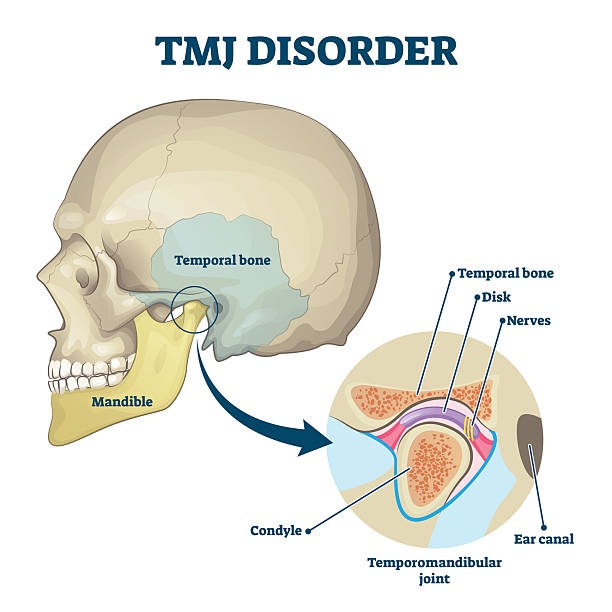
You have two temporomandibular joints (TMJs), one on each side of your face near your ears. They connect the lower jaw (mandible) to the temporal bone of the skull.
When the mandible and TMJs are properly aligned, smooth muscle actions like chewing, talking, yawning, and swallowing are possible.
Importance of TMJ in daily activities
The TMJ plays a pivotal role in everyday activities such as chewing, speaking, and yawning.
TMJ disorders can impair the ability to eat, speak, or yawn and significantly impact quality of life. Persistent symptoms often lead people to seek guidance from a chiropractor in Colorado Springs.
Overview of TMJ Disorders (TMD)
Temporomandibular disorders (TMD) are a group of more than 30 conditions affecting the TMJ, jaw muscles, and related tissues.
TMD is common and affects up to ~12 million people in the U.S., more often women aged 20–40.
2. What is the Temporomandibular Joint (TMJ)?
Location and structure of the TMJ
The TMJ is formed by the mandibular condyle (part of the lower jaw) and the mandibular fossa / articular tubercle of the temporal bone.
A fibrocartilaginous articular disc lies between these bony surfaces, dividing the joint into upper and lower compartments and helping cushion and guide movement.
How it functions
- The TMJ is described as a ginglymoarthrodial joint (hinge + sliding):
- Rotation (hinge) occurs mainly in the lower joint space.
- Translation (sliding) occurs in the upper joint space, allowing the jaw to move forward, backward, and side-to-side.
Why the jaw joint is unique and sensitive to stress/injury
Because the TMJ combines hinge and sliding motion and coordinates with multiple muscles and ligaments, it is one of the most complex joints in the body.
TMJ disorders can impair core daily actions (eating, speaking, yawning), so dysfunction causes disproportionate impact on quality of life. A Colorado Springs chiropractor often evaluates these patterns as part of TMJ assessments.
🦷 3. What Are Temporomandibular Joint Disorders (TMD)?
Definition of TMD
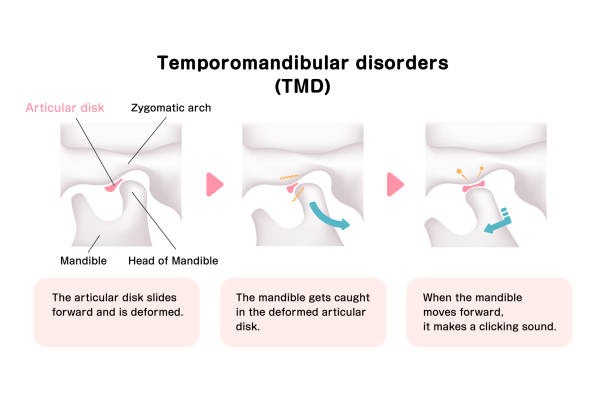
TMDs are a group of conditions that cause pain and dysfunction in the TMJ, jaw muscles, and related structures.
Difference between TMJ (joint) and TMD (disorder)
- TMJ = the actual joint connecting the jaw to the skull.
- TMD = disorders affecting that joint, the muscles that move it, and associated structures.
Common types of TMJ disorders
- TMDs can involve:
- Myofascial pain / muscle disorders (chewing muscles).
- Internal derangement of the joint (e.g., displaced disc, dislocated jaw, or condylar injury).
- Degenerative / inflammatory joint diseases (e.g., osteoarthritis, rheumatoid arthritis).
⚠️ 4. Common Causes of TMJ Disorders
Jaw injury or trauma
- TMD can be caused by trauma to the jaw or TMJ (e.g., blow, accident, whiplash) leading to tissue or disc damage.
Teeth grinding (bruxism)
- Teeth grinding and clenching (bruxism) are listed as common contributors to TMD, placing excessive stress on the joint and muscles.
Poor posture
- Poor posture, including forward head posture, can alter jaw mechanics and increase strain on TMJ and neck muscles, contributing to symptoms.
Stress and muscle tension
- Psychological stress is associated with increased jaw muscle activity, clenching, and bruxism, which can worsen or trigger TMD.
Arthritis (rheumatoid or osteoarthritis)
- TMJ can be affected by degenerative joint diseases and inflammatory arthritides, including osteoarthritis and rheumatoid arthritis.
Misalignment of teeth or jaw
- Malocclusion or bite misalignment can modify load distribution in the TMJ and is cited as a potential factor in TMD.
Connective tissue disorders
- Ehlers–Danlos syndromes (EDS), a group of genetic connective tissue disorders with generalized joint hypermobility, are associated with an increased risk of TMJ disorders and TMJ-related pain (reported in up to 71% of EDS patients in some studies).
📋 5. Symptoms of TMJ Disorders
Commonly documented symptoms:
- Jaw pain or tenderness in jaw, TMJ, or surrounding muscles.
- Clicking or popping sounds when opening/closing or chewing.
- Difficulty chewing or biting, especially hard or chewy foods.
- Lockjaw — difficulty opening or closing the mouth or the jaw getting “stuck”.
- Headaches or migraines, often related to jaw muscle strain.
- Ear pain or ringing in the ears (tinnitus) or fullness in the ear.
- Facial swelling or tenderness, especially around the TMJ region.
- Neck and upper-back discomfort and shoulder pain due to associated muscle tension.
These symptoms are also listed on the Colorado Injury & Wellness TMJ/TMD resource: jaw/face/neck/shoulder pain, difficulty chewing, clicking/popping, limited movement, headaches, earaches, vertigo, facial swelling, and bruxism.
🩺 6. How TMJ Disorders Are Diagnosed
Medical history evaluation
- Providers review symptoms (pain, noises, locking), duration, triggers (chewing, stress), habits (grinding/clenching), trauma history, and medical/dental history.
Physical examination of the jaw
- Examination includes:
- Palpating TMJs and muscles for tenderness or swelling.
- Observing jaw movement and range of opening.
- Listening/feeling for clicking or crepitus.
Checking bite alignment
- Dentists/clinicians assess occlusion and jaw alignment to see whether malocclusion may contribute.
Imaging tests (X-rays, MRI, CT scan)
- X-rays: show jaw and TMJ bones.
- MRI: visualizes soft tissues like the articular disc and surrounding structures.
- CT: gives detailed views of bony components and joint surfaces.
🧪 7. Treatment Options for TMJ Disorders
General principle: start with conservative, reversible, non-surgical treatments.
7.1 Chiropractic Care
What the clinic itself says
- Colorado Injury & Wellness states that chiropractic care is used to treat neuromuscular disorders including TMD/TMJ, employing spinal manipulation and adjustments. Many patients searching for the best chiropractor Colorado Springs for TMJ symptoms come across their specialized TMD-focused care.
- Colorado Injury & Wellness notes that chiropractic care can help treat TMD by:
Evidence base (manual/chiropractic-type therapy for TMD)
- A case report summarizing a meta-analysis of 20 randomized controlled trials states that chiropractic therapy significantly improved pain and maximum mouth opening in TMD patients.
A systematic review of manual therapy for TMD found that craniomandibular manual therapy (CMMT) improved pain and maximum mouth opening from baseline in all included studies. - A JOSPT article reports that evidence supports manual therapy and exercise (jaw, cervical, and postural) for people with TMD.
Note: these sources support the idea that chiropractic-style/manual therapy and cervical/jaw exercises can reduce pain and improve function, but they do not claim chiropractic care is a universal “cure.”
7.2 Physical Therapy
- Physical therapy for TMD typically includes jaw exercises, stretching, strengthening, posture training, and manual techniques to improve mobility and reduce pain.
- Exercise therapy alone has been shown to reduce pain and improve jaw function in TMD in several trials.
7.3 Oral Splints / Night Guards
- Occlusal splints/night guards are removable devices that fit over the teeth and are used to:
- Reduce the impact of grinding/clenching.
- Decrease muscle load.
- Protect teeth from wear.
7.4 Medication
- Common medications for TMD management include:
- Over-the-counter analgesics and NSAIDs (e.g., ibuprofen) to reduce pain and inflammation.
- Muscle relaxants (short term) for severe muscle spasm.
7.5 Lifestyle & Home Remedies
- Evidence-based self-care strategies include:
- Eating soft foods and avoiding hard or chewy items.
- Avoiding gum chewing and other overuse habits (nail-biting, chewing on pens).
Applying moist heat or cold packs to jaw muscles. - Practicing jaw relaxation and stress-management techniques.
- Performing gentle jaw and neck stretches / exercises as instructed.
7.6 Surgery (Rare Cases Only)
When conservative care fails and structural problems are confirmed, surgical options include:
- Arthrocentesis – minimally invasive flushing of the joint with fluid to remove debris and reduce inflammation.
- TMJ arthroscopy – using an arthroscope inserted via small incisions to visualize and sometimes treat joint structures (e.g., remove scar tissue, smooth bone, reposition disc).
- Open joint surgery – more invasive surgery to repair, reposition, or remove diseased tissue; sometimes used when there are bony growths or severe disc damage.
Total joint replacement – in advanced cases where the joint is severely damaged and other treatments have failed.
All authoritative sources stress that surgery is last-line and only appropriate for selected cases.
🚨 8. When to See a Chiropractor or TMJ Specialist
Based on medical guidance:
- Persistent jaw pain, tenderness, or stiffness that does not improve with simple self-care.
- Difficulty chewing or opening the mouth normally.
- Jaw that locks open or closed.
- Clicking, popping, or grating with pain or functional limitation.
- Associated headaches, ear pain, neck or shoulder pain thought to be jaw-related.
- Symptoms that interfere with eating, speaking, or sleeping, or that persist beyond several weeks. At this stage, visiting a chiropractor in Colorado Springs can help identify the root cause.
Colorado Injury & Wellness specifically invites people with jaw pain or suspected TMD/TMJ to be evaluated by their chiropractors in Colorado Springs. This makes them a convenient option for anyone seeking a chiropractor Colorado Springs CO for jaw-related concerns.
💆♂️ 9. How Colorado Injury & Wellness Provides Chiropractic Care for TMJ/TMD
According to the TMJ/TMD information provided by Colorado Injury & Wellness:
- They “offer comprehensive care for temporomandibular joint disorders (TMJ) and temporomandibular disorders (TMD)” in Colorado Springs.
- They state that these conditions can cause pain in the face or jaw, difficulty chewing, headaches, and neck pain.
- Their chiropractors provide personalized treatment plans to address these symptoms.
Under “Chiropractic Treatment for TMD/TMJ in Colorado Springs”, they state:
- Chiropractic care focuses on neuromuscular disorders, including TMD/TMJ, using spinal manipulation and adjustments.
- Treatment aims to:
- Address misalignments/imbalances in the jaw, neck, and spine that place strain on the TMJ.
- Relieve pressure on the jaw and reduce TMD/TMJ symptoms.
- Reduce muscle tension and improve jaw range of motion using massage, stretches, and exercises around the jaw.
- They also provide specific stretches and exercises (jaw stretches, neck stretches, lip and tongue stretches, jaw relaxation techniques, jaw strengthening), all positioned as potentially helpful for TMD/TMJ.
These clinic claims align broadly with the general evidence that manual therapy plus exercises can reduce pain and improve jaw mobility in TMD, but they are clinic-authored statements, not neutral clinical guidelines.
🛡️ 10. Prevention Tips for TMJ Disorders
Evidence-based prevention & self-care measures:
- Avoid chewing gum and limit very hard/chewy foods to reduce overuse.
- Practice good posture, particularly avoiding forward head posture and prolonged slouched positions.
- Reduce stress to decrease clenching and muscle tension (e.g., relaxation techniques, stress-management strategies).
- Avoid or reduce grinding or clenching (daytime awareness; night guards when indicated).
- Follow jaw exercises and stretches recommended by a clinician (jaw opening, neck stretches, jaw relaxation exercises) to maintain mobility and reduce tension. Many individuals benefit from the support of a Colorado Springs chiropractor when learning posture corrections and muscle-relaxation techniques.
✅ 11. Final Thoughts / Prognosis
If your TMJ symptoms are not improving with home care, getting a professional evaluation can help you understand what’s contributing to your discomfort. Colorado Injury & Wellness provides comprehensive chiropractic care for TMJ/TMD and creates personalized treatment plans that focus on jaw alignment, muscle balance, and posture support.
You can learn more about TMJ/TMD care by visiting their information section, or schedule your visit through their online appointment page. This gives patients easy access to detailed guidance and convenient booking options.
The clinic is located at 1819 West Colorado Ave., Colorado Springs, CO 80904, making it a convenient choice for individuals seeking trusted chiropractic care in the area. Their team is committed to helping patients reduce pain, restore jaw function, and return to their daily routine with compassionate, conservative care.